

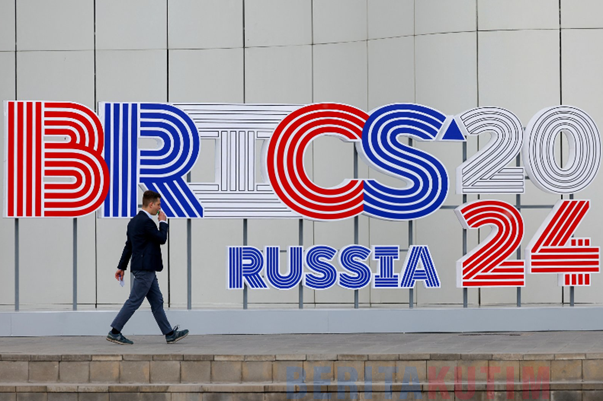
BERITAKUTIM.COM,- The initial BRICS cooperation began in 2001 under the name BRIC, an acronym coined by Goldman Sachs for Brazil, Russia, India, and China. It later became BRICS after the addition of South Africa in 2010. The primary mechanism behind the formation of BRICS is to promote peace, security, development, and cooperation. Furthermore, BRICS aims to make a significant contribution to the development of a more just and equitable world.
Amid the current global economic crisis, many other countries view BRICS member countries as new drivers of global economic growth. This is evident in BRICS trade and investment in low-income countries, which have become a key support system for their economies amidst the current global financial crisis. This raises the question of how important is BRICS for Russia today?
Since Russia’s severing of relations with the West in 2014, Russia has reoriented its focus toward non-Western institutions to strengthen its efforts to dismantle the post-Cold War Western dominance. This step was also driven by economic incentives and Russia’s need to meet national development goals. In this regard, we can view it from the perspective of the concept of national interest.
However, this does not rule out the possibility that definitions of national interests may shift depending on the stance taken, such as idealism versus realism, long-term versus short-term concerns, and traditional versus individual concerns. National interests also determine long-term and short-term foreign policy efforts.
The existence of the BRICS has become an integral part of Russia’s efforts to pursue its national interests without Western influence. This is reflected in the 2013 agreement on the Concept of the Russian Federation’s Participation in the BRICS. The agreement identifies the BRICS as its primary long-term foreign policy vector. This can be seen in the inclusion of Russia’s strategic goals in the BRICS:
- Reforming the international monetary and financial system to facilitate Russianeconomic growth
- Expanding foreign policy cooperation with BRICS members
- Using BRICS participation to improve Russia’s foreign policy and strengthen Russia’s position in the international arena
- Promoting bilateral relations with member states
- Expanding Russia’s cultural presence globally
Looking at the BRICS’ performance in recent years, we can see how it performs not only at routine meetings but also through regular interactions covering trade, finance, security, health, and agriculture. Some key areas of BRICS activity that can be seen in the form of tangible results include monetary system reform, ensuring compliance with established trade rules within the BRICS, developing complementary economic cooperation, maintaining global stability, and supporting the role of international institutions and international law. Furthermore, the BRICS’ free and informal nature provides advantages for Russia and indirectly allows Russia to assert its position as a key actor in the emergence of non-Western global governance structures. Therefore, for Russia, the existence of BRICS is a crucial factor in reaffirming its non-Western global aspirations in a relatively non-confrontational manner.
Many politicians and observers, particularly from the West, have criticized and refuted the notion that BRICS is purely theoretical and devoid of any prospects, making it highly detrimental. It’s understandable why the West tries to downplay the role of BRICS, given that, from its perspective, BRICS is a cooperative alliance emerging from rival countries. However, this doesn’t discount the numerous benefits Russia derives from BRICS. As previously explained, BRICS serves as a bridge for Russia in pursuing its national interests, eliminating or severing Western influence. In this context, BRICS has become a highly useful tool.
Refference:
- Burchill, S. (2005) The National Interest in International Relations Theory. New York: Palgrave Macmillan
- Frankel, J. (1970) National Interest. London: Palgrave Macmillan
- Chen, J. (2021, Mei 29) Brazil, Russia, India, China and South Africa (BRICS). Investopedia. https://www.investopedia.com/terms/b/brics.asp
- Kapoor, N. (2020, Maret 06) BRICS in Russian foreign policy. Observer Research Foundation. https://www.orfonline.org/expert-speak/brics-in-russian-foreign-policy61978/
- South Africa. Events. (n.d). Fifth BRICS Summit – general background. https://www.gov.za/events/fifth-brics-summit-general-background
- Toloraya, G. (2015, Maret 19) Why Does Russia Need BRICS?. Russia In Global Affairs. https://eng.globalaffairs.ru/articles/why-does-russia-need-brics/
- Van Der Togt, T. (2019, Februari 04) Is Brics A Useful Framework For Russia’s Global Agenda?. Clingendael Spectator. https://spectator.clingendael.org/en/publication/bricsuseful-framework-russias-global-agenda
Writer: Salsabila